
Cut Grade

What is cut grade?

In essence, the cut refers to how well the surfaces of diamonds interact with light. A well-cut diamond is brighter and sparkles better compared to a poor cut.
There are 3 things that affect the cut quality of a diamond. These include:
● Proportions: the angles and relative dimensions of a polished diamond.
● Symmetry: the accuracy of the finished diamond’s shape and facet placement.
● Polishing: The overall condition of the diamond surfaces.
 
Many people often confuse the cut with the shape of the diamond. They are not the same thing and it doesn’t help that many jewellers use the two terms interchangeably.Strictly speaking, shape refers to the outline of the diamond (e.g. heart and cushion), while cut refers to the combination of the diamond’s proportions and finish (symmetry/polish).
Cut can make a diamond appear larger, enhance the colour of surfaces and help to hide inclusions. This means you can easily get a “free” boost to the other 3C elements (colour, carat and clarity) with just a better cut!

Strictly speaking, shape refers to the outline of the diamond (e.g. heart and cushion), while cut refers to the combination of diamond proportions and finishing (symmetry/polish).
Cut can make a diamond appear larger, enhance the colour of surfaces and help to hide inclusions. This means you can easily get a “free” boost to the other 3C elements (colour, carat and clarity) with just a better cut!

The visual difference between a well-cut diamond and a poorly cut diamond is huge!

The fact is that a well-cut diamond has better proportions and does not hide carats in the side profile. This makes the diamond look larger in weight compared to another diamond that has been cut deep and looks smaller up top.
Better light reflection makes the diamond lighter in the right direction, as more light is reflected back to the viewer’s eyes. Finally, well-cut diamonds sparkle strongly, which can help hide inclusions.

What does a well-cut diamond look like in real life?

Watch the following video of an E-coloured VVS1 diamond. This diamond has been personally hand-picked for the best cut and sparkle. It gives you an idea of what a well-cut diamond looks like in real life.

Did you know that the amazing play of light shown by diamonds is actually caused by the laws of physics?

At the base level, the amount of sparkle depends on how the light rays are refracted and reflected by the diamond. Therefore, the precise positioning and alignment of each surface is important, as they act like tiny mirrors interacting with light.In well-cut stones, much of the light entering the diamond is reflected back to the viewer’s eyes. This makes the diamond bright and enhances its brilliance.When the cut quality of diamonds is less than ideal, light is scattered through the sides of the diamond instead of reflecting back into the viewer’s eyes. As a result, the diamond is less bright and darker.

Understanding the diamond cut classification - A brief summary

A gemological laboratory such as GIA usually performs cut grading of diamonds by checking a number of parameters such as diamond proportions, polish/symmetry values, cut size and edge thickness.A typical round clear diamond grading report will show a diagram similar to the example below. In this diagram, the average measurements of the opposite edges are plotted.

GIA-REPORT

Depending on how technical (or serious) you want to be, you can assess each of these parameters and examine the correlations between them.
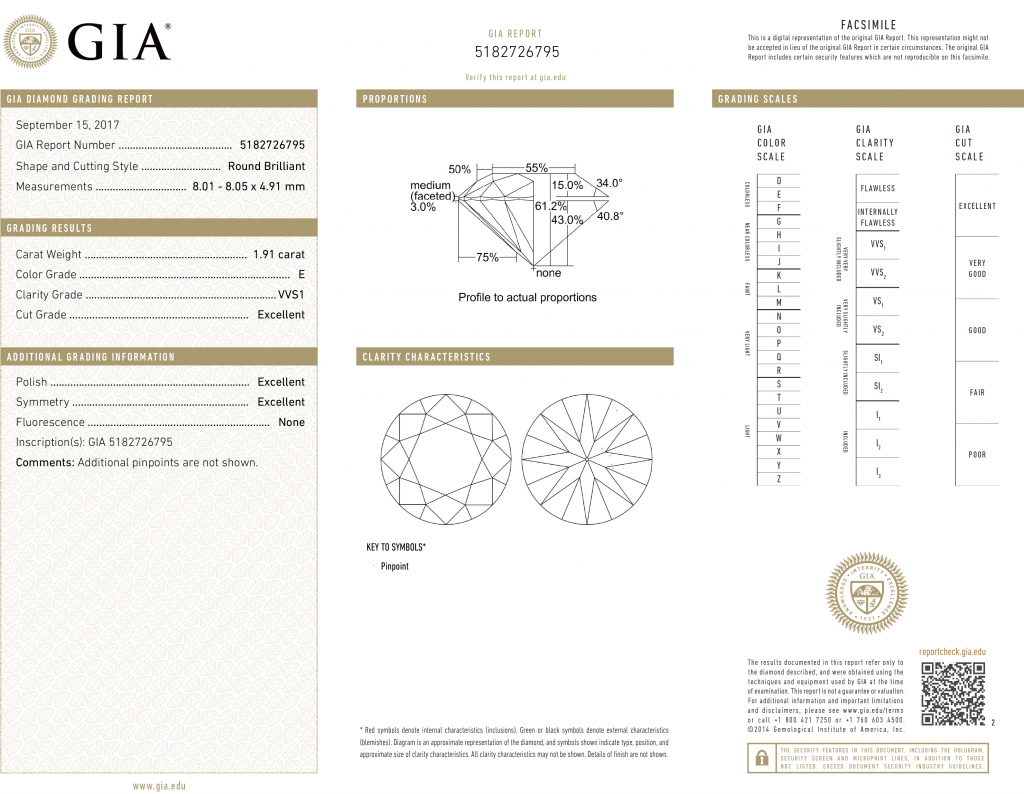
Depending on how technical (or serious) you want to be, you can evaluate each of these parameters and examine the correlations between them.We recommend buying only round diamonds with a GIA triple Excellent cut grade.Gemological laboratories such as GIA or AGS take the relative variations of diamonds into account when evaluating the cut grade of a diamond. If there is a problem in a particular section of the cut ratio, the diamond is downgraded and given a correspondingly lower cut grade.
This means that even if you blindly choose any diamond with a GIA triple brilliant cut, it is unlikely that you will end up with an ugly gemstone. However, if you want to select a crop of cream from among the GIA triple stones, you will have to do some extra work in filtering your choices.
 
By now you should know that cut is one of the most important factors in diamond selection. Before we get into more serious matters, let me give you a little history on the evolution of diamond cut grading.
 
In 2005, GIA was the first gemological laboratory to create a grading system, and they were also one of the first laboratories to introduce the concept of cut grading for round diamonds.
Since then, other gemmological laboratories have started to develop their classification systems for cut grading. In particular, the American Gem Society (AGS) laboratory created a numerical cut grading system to evaluate the light performance of diamonds.
Today, we have reached a stage where scientific research has allowed us to judge the clarity and beauty of a diamond based on its proportions. One such tool developed by GIA is the FacetWare Cut Estimator.
Account registration is free and the tool is available to everyone. Once logged in, you can enter the numbers from the grading report and get an instant estimate of the cut grade of your diamond.

Different cut classes for round diamonds

First of all, I want to be very clear about the classification of laboratories. You should ONLY buy diamonds graded by the GIA or AGS. If you buy a diamond that is graded by another lab or has an in-house “certificate”, you may be fooled by an increased rating.

It's as simple as that.

The GIA and AGS are the world’s leading diamond grading authorities and provide uniform grading standards. For cut grading, the cut of the diamond is presented in the GIA and AGS diamond grading reports respectively.While the GIA and AGS use slightly different systems for grading diamonds, there is one thing that is universal. The overall optical performance of a diamond is important in determining its cut quality.
 
Although GIA and AGS use slightly different systems for evaluating diamonds, there is one thing that is universal. The overall optical performance of a diamond is important in determining its cut quality.
 
Without delving into the smallest details, I recommend sticking with at least an Excellent/Very Good grade without settling for worse.
STAY AWAY from the good/moderate/poor categories. Don’t throw money down the drain by buying poorly cut diamonds. In fact, it makes much more sense for you to buy cheap faux diamonds than to spend money on a diamond that doesn’t shine nicely.

Here are my interpretations of the different types of cut grades

I don’t know about you, but when I buy a diamond, I only look at diamonds that have the BEST sparkle and clarity. My personal standards are very high for cut quality and I recommend you do the same when you are shopping for your store , it makes a difference.

Interpreting the different classifications and presenting them clearly

● Ideal / excellent: Nice diamonds
● Very good: Okay diamonds with mediocre fire and brilliance.
● Good: poorly cut diamonds with poor dimensions and sparkle.
● Mediocre: Absolutely awful. The diamonds look too dark and lack contrast.
● Poor: worthless junk. The diamonds have major flaws and are ugly.

Most of the diamonds on the market are cut in bad manners, and the GIA cutting scale classifies them as “polite”. If your diamond does not have an excellent / very good cut rating (GIA), don’t waste your time with it.